The apex predator of product analysis.
Apex is the AI inside Arbitrage Stalker, the validate step of seller-led sourcing. Your tracked sellers surface the lead; Apex confirms the buy. It reads a product's full history the way a veteran seller does: price history, sales rank, offer depth, competition. Then it calls the deal: Strong Buy, Buy, Watch, or Pass, with a 0-100 score, the rationale, and the top risk. Seconds, not spreadsheets.
7 days free · Apex credits on every plan · Cancel anytime
This is an actual Apex Read.
Captured live in the app: Crocs Classic Clog. Apex read the price and rank history and called it, with the score, the why, the biggest risk, and a risk-adjusted max buy cost. One credit, a few seconds. Your reads look exactly like this, on your products.
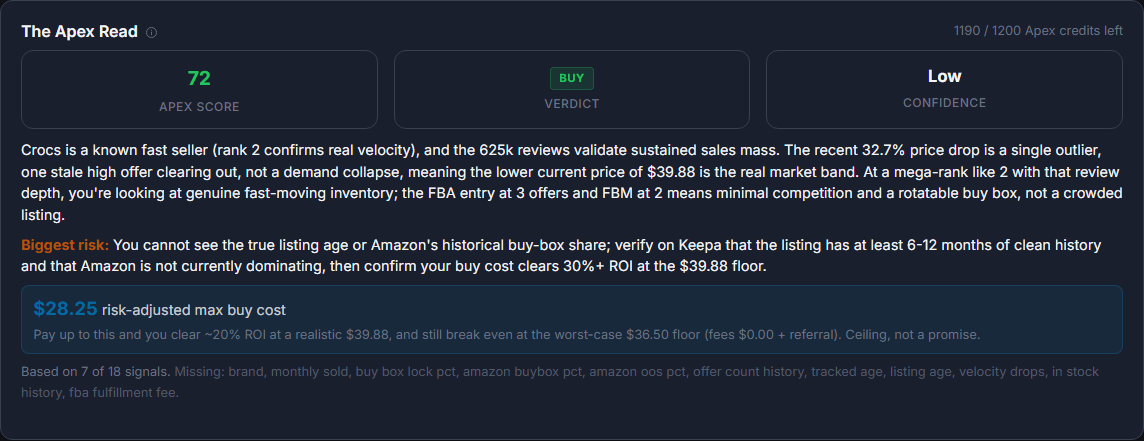
Six fields. Zero fog.
Every read comes back in the same format, so you can compare deals instead of decoding paragraphs.
Apex Score, 0-100
One number for how strong the deal is, calibrated across the catalog Stalker watches. 87 means something because 41 does too.
The verdict
Strong Buy, Buy, Watch, or Pass. A call, not a maybe. The four-way verdict forces a decision the way a veteran would make one.
The rationale
Why, in two sentences max. The demand signal, the competition picture, the price direction. No essay, no filler.
The top risk
The one thing most likely to burn you on this listing: Amazon on the buy box, a crashing price, thinning demand. Named before you buy, not after.
Risk-adjusted max buy
The ceiling you can pay and still come out ahead, discounted for the risk Apex sees. Enter your real buy cost and it judges your actual ROI instead.
Confidence + data depth
How sure Apex is, and how much history it had to work with. When the data is thin, it says so instead of acting certain.
One click between you and the call.
Open any product record
Every product Stalker surfaces, across 342K+ catalogued, carries its full price and sales-rank history. That history is what Apex reads.
Get the Apex Read
One click, one credit. Apex reads the price history, rank trend, and competition, then returns the verdict in seconds.
The verdict sticks
Reads are cached. Re-opening a verdict is free, and the call only changes when the data changes enough to matter.
Skeptical of AI? Good. So were we.
Apex was built for sellers who have been burned by tools that bluff. So it does not bluff.
It shows its confidence
Every read carries a confidence level and a data-completeness flag. When the history is thin, Apex says so instead of acting sure.
Same data, same call
Verdicts are cached and consistent. Run the same product twice and you get the same answer, not a slot machine.
It never guesses your numbers
Apex will not invent an ROI to impress you. Enter your buy cost and the ROI is real. Leave it out and you get a risk-adjusted max buy ceiling, clearly labeled as one.
You stay the predator
Apex is a second set of veteran eyes, not a replacement for yours. It points. You decide. Every verdict ends with your call, not its.
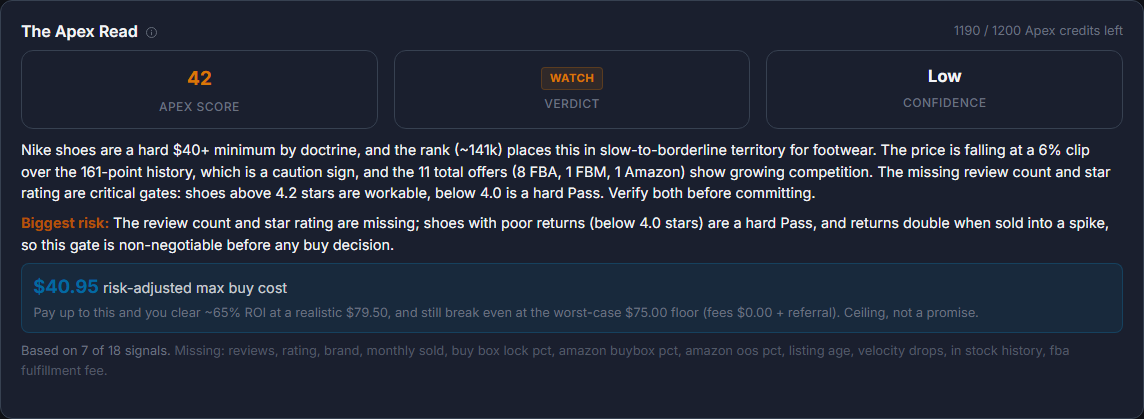
Proof, not promises. Here is a real read on a listing with thin data. Apex scores it 42, calls Watch, flags low confidence, and lists every signal it could not see. That is what refusing to bluff looks like.
Scout. Hunter. Predator. Apex.
Every plan hunts with Apex. Bigger plans just hunt more. One credit per fresh read, cached re-reads free, credits reset monthly.
“I've been using Arbitrage Stalker a lot lately. I got one storefront in there and, oh my god, it's just a gold mine.”
Card on file, no charge until day 8 · Cancel in two clicks
Want Apex inside your own stack?
The Apex API puts the same engine behind your own scripts, sheets, and tools: score an ASIN, ask about it, or pull Source Radar, in the same verdict format, metered on the same credits. Access is granted per account, by application. Book a 15-minute call and tell us what you are building.
Apex: questions sellers ask
Your competitors don't sleep.
Now you don't have to either.
Start tracking your first seller in 90 seconds. 7 days free, then $29/month. Cancel anytime.